Junior Showmanship, 4-H & FFA Steers
What to Look for in a Prospect Show Calf
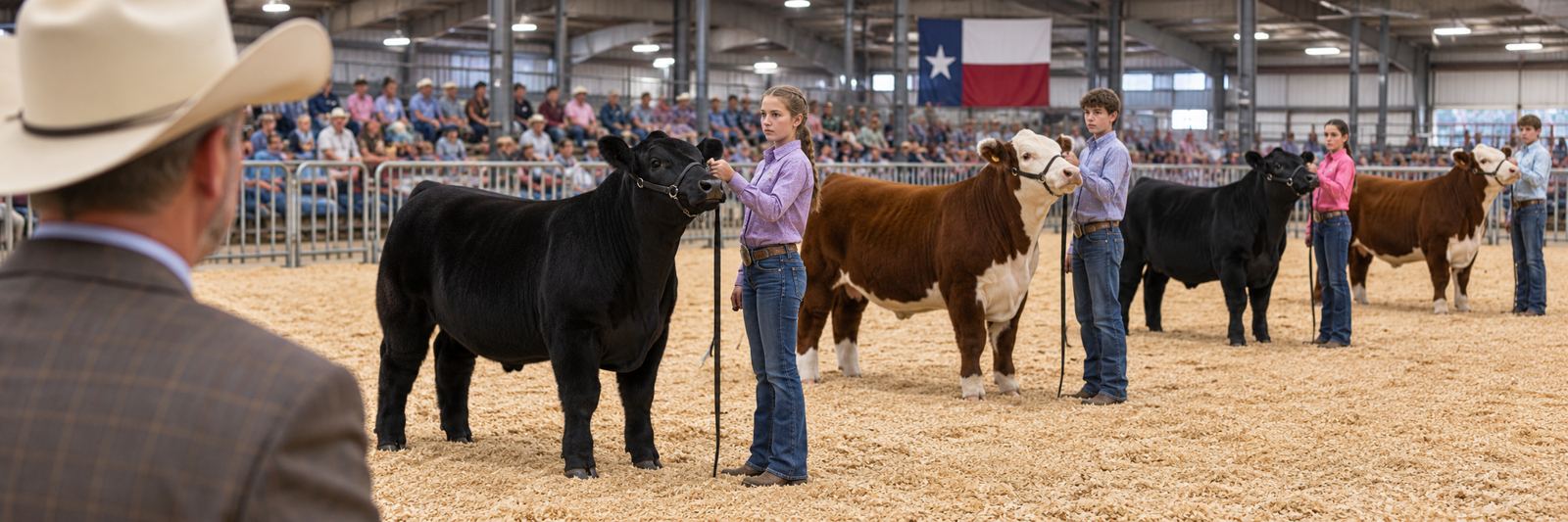
Walk into any pen of show prospects and every calf looks like a winner for about four seconds. After that you start seeing things: the one that toes out, the one that's short in the neck, the one that stands like he just heard bad news. Show calf conformation is just the practice of seeing those things on purpose, in order, before you buy.
There's no perfect calf, and judges won't expect one from a young animal. What you want is a calf with no serious flaws, a few real strengths and enough room to grow into the kind of animal that fits your show. Here's how to break it down so you don't get lost in the pen.
Start with the big picture
Stand back far enough to see the whole animal. Ten to fifteen feet is about right. Look at him from the side and decide if he looks balanced, meaning the front, middle and back seem to belong to the same calf. Then look at him from behind and in front. Balance and eye appeal are what a judge notices first, so train yourself to notice them too.
The old advice is to look at an animal the way you'd look at a car lot from the highway: general shape first, scratches later. Then walk up close and go through the parts.
The parts, one at a time
Frame and size
Frame refers to the skeletal size of the animal, usually described by height and length. For young calves, it's a way of estimating how big he'll be later. A larger-framed calf typically finishes at a heavier weight and takes longer to get there, and a smaller-framed calf finishes sooner at a lighter weight. Neither is wrong. What matters is whether the calf's expected finish fits your show's weight limits and your timeline.
Topline and structure
Look at the top of the calf from the neck to the tailhead. You want a strong, fairly level line that doesn't dip behind the shoulders or fall off at the hips. A neck that comes out of the shoulder smoothly and is clean in the throat helps the animal look sharp and walk well. The shoulder should lay in smoothly, not stick out or look like a coat hanger.
Feet and legs
This is the part new exhibitors skip, and veterans stare at. Watch him walk toward you, away from you and past you. Legs should track straight, with a long, free stride. Watch for:
- Toed-out or toed-in feet.
- Stiff, short or choppy steps.
- Pasterns that are too upright or too weak.
- Hooves that are cracked, uneven or heavily overgrown.
- Hocks that are very close together or rubbing.
A sore calf isn't going to do much for your confidence. There's more on this in foot trimming and lameness in show cattle.
Muscle
For a market steer, muscle is a huge part of the picture. Look at the loin, the rear leg (stifle and round) and the forearm. From behind, the animal should look wide and full, with the muscle carrying down the leg. A flat, narrow rear view is a warning sign. Look at the front too: a calf with a chest that's wide and full usually has the base to carry muscle. Be careful not to confuse fat or hair with muscle. A calf in a fresh coat of hair and a thick layer of grain can fool a first-timer, so feel for what's there.
Depth and capacity
Depth of rib and body capacity show how much room he has for growth. A calf that's deep through the heart and flank with a good spring of rib is a better bet than a slab-sided one. Think of capacity as the size of the engine: a bigger engine doesn't help if the wheels are crooked, but it's nice to have.
Bone
You want bone that's in proportion to the frame. Too fine and the calf may not hold up as he grows. Too heavy and he can look coarse. Beginners often assume thick means strong. It might, but only if it fits the rest of the animal.
Hair, skin and eye appeal
Hair coat and skin tell you about health and care, though they can be changed with grooming and time. A healthy calf has a shiny, soft coat, clear eyes and a bright expression. Eye appeal is real, but it's the last thing you check, not the first. Pretty is cheap. Sound is expensive.
A quick scoring sheet
| Trait | What to see | Weight in your decision |
|---|---|---|
| Feet and legs | Straight, free-moving, sound | High |
| Structure and topline | Level, strong, smooth shoulder | High |
| Muscle | Full rear, loin and shoulder | High for market steers |
| Temperament | Calm, curious, settles quickly | High for beginners |
| Frame and size | Fits your show weights | Medium |
| Hair and eye appeal | Healthy, bright, well kept | Lower, because it can change |
Common mistakes
- Judging from the photo. Photos flatter. See the calf in person if you can.
- Falling for a single feature. One great hip doesn't fix a bad set of legs.
- Ignoring temperament. A calf that doesn't settle will slow every part of your project.
- Looking at only one calf. Compare several in the same pen at the same time.
- Not asking for help. Your ag teacher or extension agent has seen hundreds of calves. Use that.
Practice makes it easier
The best way to get better at evaluating cattle is to practice. Go to a local show and watch the classes from the rail, then listen to the judge's reasons. Look at calves in your own county and compare them using the same checklist. The South Dakota State University Extension 4-H beef project page collects youth beef resources that include selection materials. If you plan to buy soon, best breeds and crosses for a market steer project explains how type varies, and where to buy a show calf and what to ask the breeder covers the shopping side. Once the calf is home, showmanship basics shows how the judge will view you.
Quick answers
What is the most important trait in a show calf?
For a beginner, it's structural soundness and temperament. A calf that moves well and stays calm lets you learn the rest of the project without fighting him every day.
Can I judge a calf's muscle when he's young?
You can get a rough idea, especially from behind and through the loin, but young calves change. Compare several calves of similar age and ask an experienced person to help.
Does hair matter when buying a calf?
It matters less than structure and health, because hair can be grown and groomed. Look at coat quality as a sign of health and care, not as the main reason to buy.